

Milk protein as an alternative to eggs - it's possible!
Eggs play a central role in cooking, as they are found in many recipes, from pastries to savory dishes. Their versatility and various functional properties make them indispensable ingredients.
However, the use of eggs is now being called into question due to the allergies they can cause, ethical concerns related to their production, and the increasing popularity of special diets such as veganism.
Faced with these challenges, the agri-food industry is exploring various alternatives to eggs. Among these, milk protein stands out for its potential to meet the needs of both consumers and manufacturers.
However, the use of eggs is now being called into question due to the allergies they can cause, ethical concerns related to their production, and the increasing popularity of special diets such as veganism.
Faced with these challenges, the agri-food industry is exploring various alternatives to eggs. Among these, milk protein stands out for its potential to meet the needs of both consumers and manufacturers.
Special diets, allergies, cost: why look for alternatives to eggs?
Today, there are several reasons to look for alternatives to eggs, which are found in many recipes.
Firstly, egg allergies, although less well known than milk allergies and intolerances, are quite common. In fact, globally, eggs are the second most common allergenic food after milk, and around 2.5% of adults suffer from this allergy.
In addition, poultry farms often face health issues, particularly epizootics (diseases that simultaneously affect a large number of animals) such as avian influenza. These epidemics lead to mass culls, egg shortages, and cost fluctuations every year, making supply difficult.
Finally, raw or improperly handled eggs can be a potential source of salmonella. In addition, they require specific storage conditions, including refrigeration, and have a relatively short shelf life compared to other ingredients such as powdered dairy ingredients, which can be stored for 18 to 24 months.
Alternatives to eggs: what functions should dairy protein fulfill?
To find good alternatives to eggs, we first need to understand what functions they perform in food matrices.
Eggs offer many properties that are useful in a variety of recipes. Egg yolk has binding properties, which help to maintain a homogeneous food matrix. It is also used as a thickener in sauces, providing a rich and creamy texture. Thanks to the lecithin it contains, egg yolk also has emulsifying properties.
Egg whites have foaming properties, trapping air and creating a light and fluffy texture in preparations such as meringues. The moisture and fat content of egg whites makes preparations moist. Finally, eggs contribute to the coloring of foods, either through the Maillard reaction or browning.
Egg whites have foaming properties, trapping air and creating a light and fluffy texture in preparations such as meringues. The moisture and fat content of egg whites makes preparations moist. Finally, eggs contribute to the coloring of foods, either through the Maillard reaction or browning.

Egg substitutes must therefore provide these functional properties in order to be effective alternatives.
Today, there are several alternatives to eggs. For example, soy or sunflower lecithin, which has emulsifying properties, or soy protein isolates, which have emulsifying and texturizing properties, can be used. Red algae can also be used for its binding and texturizing properties. However, none of these ingredients can replace all the functions of egg whites, meaning that combinations are required.
Today, there are several alternatives to eggs. For example, soy or sunflower lecithin, which has emulsifying properties, or soy protein isolates, which have emulsifying and texturizing properties, can be used. Red algae can also be used for its binding and texturizing properties. However, none of these ingredients can replace all the functions of egg whites, meaning that combinations are required.
Alternatives to eggs: the benefits of milk protein and its applications
Milk protein offers a great alternative to eggs in various food applications. However, like the alternatives mentioned above, it can’t replace all the functional properties. The right milk protein must be chosen depending on the property you are looking for.
The properties of milk protein depends on its nature, the process used to obtain it, and the treatment applied when it is incorporated into a food matrix (e.g., heat and/or chemical treatment).
The properties of milk protein depends on its nature, the process used to obtain it, and the treatment applied when it is incorporated into a food matrix (e.g., heat and/or chemical treatment).
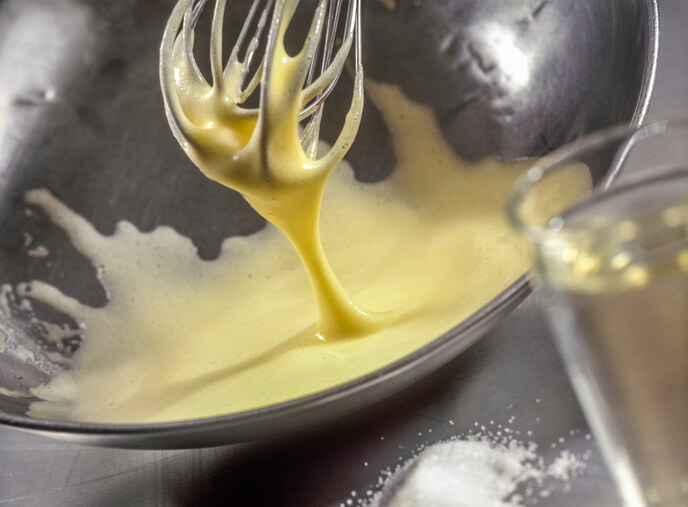
Some milk protein has very good emulsifying properties. This is true of casein, which can replace egg yolk in mayonnaise-type sauces. Native whey protein, on the other hand, has foaming properties, making it a good substitute for egg white in the preparation of meringue, for example.
Others, such as whey protein, have texturizing and gelling properties. This diversity of properties makes it possible to select the right milk protein to ensure a moist texture for a sponge cake, a light texture for a mousse, or stability for a sauce.
Others, such as whey protein, have texturizing and gelling properties. This diversity of properties makes it possible to select the right milk protein to ensure a moist texture for a sponge cake, a light texture for a mousse, or stability for a sauce.
To meet the challenges of the widespread use of eggs in the food industry, combined with consumer expectations and industrial formulation constraints, Eurial offers a variety of dairy ingredients with different functional properties. We offer a range of solutions as egg substitutes:
- Eurimilk 80 NS, a soluble native protein solution with a protein content of 80%. It has thickening, foaming, and gelling properties, which are ideal for soft and moist textures such as those found in surimi.
- Eurimilk 60.1, a functional dairy protein with excellent emulsifying properties. It can be used in many formulations such as sauces, mayonnaise, mousses, ice cream, etc.
- Eurimilk 70 PL, a 70% protein concentrate. It has texturizing properties that add a soft texture to bakery, pastry, and confectionery preparations.
Partner with us for your next project
At Eurial I&N, we firmly believe that milk proteins offer a reliable alternative to eggs. Let’s explore tailor-made solutions together to develop high-performance, stable and safe formulations that are perfectly suited to your needs.
- French sourcing
- Traceability
- New industrial process for physical protein concentration
- Numerous applications.
Sources :
- Frontiers, Frontiers | Research progress on the allergic mechanism, molecular properties, and immune cross-reactivity of the egg allergen Gal d 5, 07/07/2023 disponible ici: https://www.frontiersin.org/journals/nutrition/articles/10.3389/fnut.2023.1205671/full
- ANSES, Influenza aviaire en 11 questions, 02/06/2023, disponible ici : L’influenza aviaire en 11 questions | Anses – Agence nationale de sécurité sanitaire de l’alimentation, de l’environnement et du travail
- ANSES, Qu’est-ce que la Salmonellose et comment s’en prévenir ? 22/03/2022, disponible sur : Qu’est-ce que la salmonellose et comment s’en prémunir ? | Anses – Agence nationale de sécurité sanitaire de l’alimentation, de l’environnement et du travail
- Les oeufs, Science culinaire, disponible ici : https://lesoeufs.ca/oeufs101/science-culinaire/
- Peakbridge, Egg Alternatives: A guide to the landscape of functional replacers of the chicken’s egg, 18/07/2022, disponible ici : https://peakbridge.vc/egg-alternatives-a-guide-to-the-landscape-of-functional-replacers-of-the-chickens-egg/