

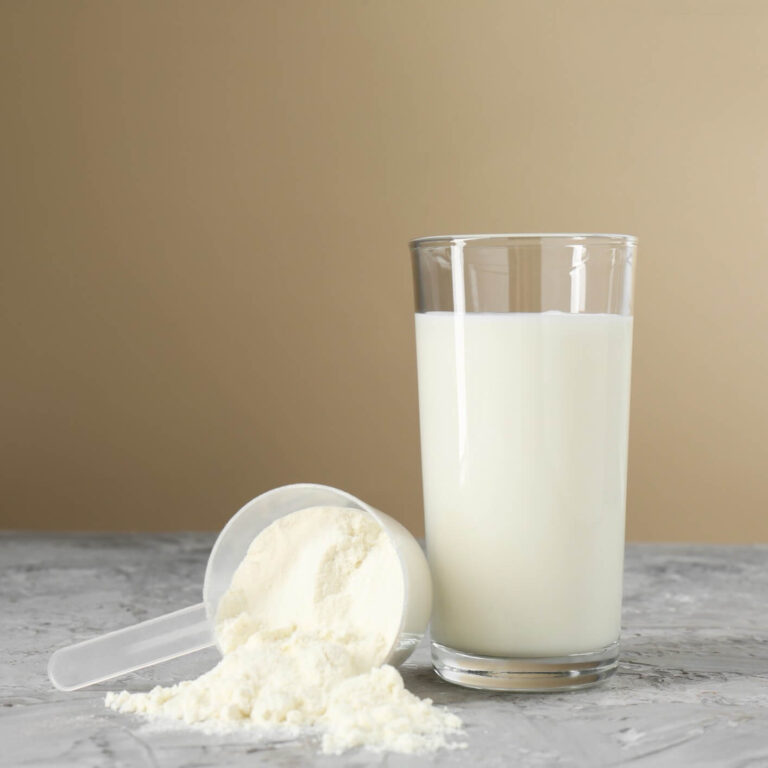
Have you considered milk proteins as an alternative to E471?
Food additives, whether natural or artificial, are widely used in the food industry. These substances are added to food for technological purposes, as preservatives, flavor enhancers, colorants, or thickeners, and are found in many foods consumed on a daily basis (1). In recent years, however, consumer perceptions of certain additives, such as E471, have changed.
Against a backdrop of demand for natural ingredients and transparency, “additive-free” products are gaining ground. The challenge for food industry players is therefore clear: they need to replace additives without compromising product quality.
Could milk proteins offer a good alternative to E471?
E471: what are its uses and implications in products?
E471, or mono- and diglycerides of fatty acids, is an additive obtained synthetically by hydrolyzing animal or vegetable fats.
Due to its emulsifying and stabilizing properties, it is used in many products such as baked goods, cereals, creams, oils, pasta, etc. This additive helps, for example, to preserve the moisture content of dough, improve the spreadability of margarine, and promote the aeration and expansion of ice cream (2).
Why look for an alternative to E471?
Despite its technological effectiveness, E471 is now increasingly being called into question. It has been given a rating of ¾ by UFC Que Choisir, which corresponds to the category of additives that are not recommended (2).
Some studies, including those conducted by Inserm and the NutriNet-Santé cohort, have highlighted a potential link between the consumption of certain emulsifiers such as E471 and an increased risk of diseases such as cancer (general cancer, prostate cancer, and breast cancer) and cardiovascular disease (3,4). It should be noted, however, that these are observational studies, which alone are not sufficient to establish a causal link.

Furthermore, E471 is clearly identifiable in a list of ingredients, which runs counter to the trend toward naturalness. With growing awareness of the link between food and health, consumers are looking for clean label products: shorter, easier-to-understand ingredient lists, without controversial additives and more natural ingredients. This movement is driven by certain initiatives that influence purchasing decisions. One example is the Yuka mobile app, available in 12 countries and used by 70 million consumers worldwide (6).
These new expectations pose a major challenge for the food industry: finding alternatives to E471 and other controversial additives that have the same functional properties and guarantee product quality.
Dairy proteins as alternatives to E471 – it is possible!
In the search for clean label solutions, milk proteins stand out as an alternative to E471. There is a wide variety of milk proteins with multiple properties, including emulsifying capabilities like E471.
Replacing an additive is no trivial matter. It requires ensuring that the final characteristics of the product remain the same: texture, stability, taste, shelf life, etc.

Milk proteins are emerging as a credible alternative to E471:
- They are a clean-label ingredient that is not controversial. They are a simple ingredient, produced using physical rather than chemical processes, minimally processed, GMO-free, preservative-free, and familiar to consumers. However, some nutritional assessment apps, such as Yuka, have a rating system based on nutrient concentrations and the degree of processing. In this case, milk proteins may be poorly rated, even though they are used as an alternative to an additive. This highlights the importance of contextualizing their use.
- They have emulsifying properties similar to E471 and are already used in a wide variety of formulations: margarines, sauces, bakery products, pastries, prepared meals, mousses, frozen desserts, etc (7)
Beyond their functional role, milk proteins provide nutritional benefits as a source of essential amino acids.
At Eurial I&N, we offer a range of dairy ingredients that can be easily incorporated into your food formulations, such as yogurts, ice creams, mousses and desserts, ready meals, sauces, and bakery and pastry products.
Among Eurial’s solutions as an alternative to E471 is Eurimilk 60.1.
This is a functional blend with a protein content of 60%. This ingredient has been tested as an alternative to E471 for various applications and is highly promising. Eurimilk 60.1 has emulsifying and stabilizing properties in carbonara-type sauces similar to those of E471. It also contributes to the proper expansion of ice cream and has a neutral taste.
We are convinced that milk proteins offer a functional alternative to E471. Let’s discuss your projects together to develop reliable, clean-label formulations.
Why not put your trust in us for your next project?
With 100% French sourcing, complete traceability, an innovative industrial process, and numerous possible applications, we put our expertise at the service of your ambitions.
Sources :
- ANSES, Le point sur les additifs alimentaires, 07/12/2012
- UFC Que choisir, Test E471 Mono et diglycérides d’acides gras, 2018
- Inserm, Association entre la consommation d’additifs alimentaires émulsifiants et le risque de maladies cardiovasculaires, 2023
- Etude NutriNet Santé, Additifs alimentaires émulsifiants et risque de cancer : Résultats de la cohorte prospective française NutriNet-Santé, 2024
- Kantar, Food 360 : tendances mondiales de consommation alimentaire, 2024
- YUKA, Dossier de Presse, 2024
- Université de Lille, Sciences et Technologies, Protéines animales, 2016